Gear Grinding Machine
Selection & Kinematics Guide
Maximize gear accuracy up to ISO 1328 Grade 1. Master the trade-offs of continuous generating grinding vs. profile form grinding, calculate MRR, and secure your thermal burn protection protocols.
📋 Table of Contents
1. Introduction to Hard Finish Gear Grinding
In heavy machinery manufacturing, aerospace drivetrains, and wind-turbine gearbox assemblies, gears are subjected to immense operational torque and rotational shear stresses. To handle these loads, gear blanks must undergo **carburizing and quench hardening** to secure high surface hardness. However, heat treatment processes warp the steel geometry, inducing critical lead, profile, and spacing pitch errors.
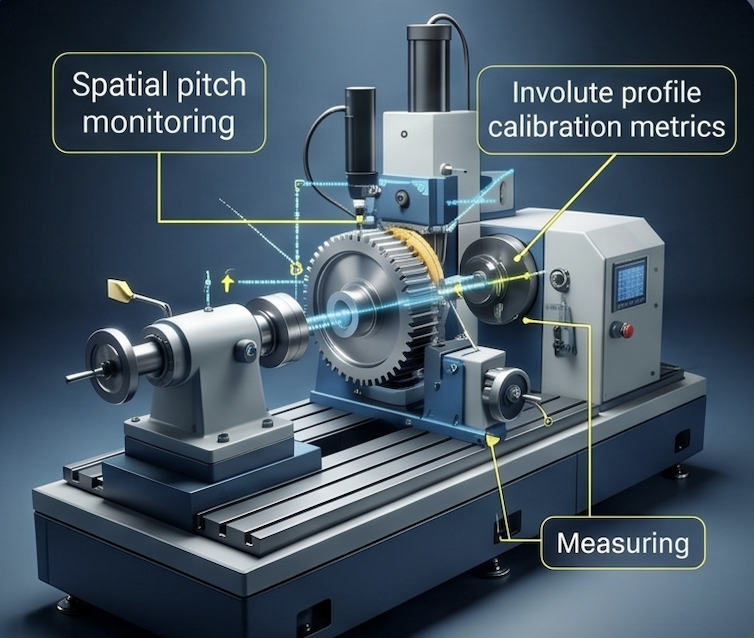
A **gear grinding machine** is an ultra-precision CNC machine tool configured to grind away these warp layers. By establishing sub-micron accuracy tolerances, gear grinders ensure perfect conjugate teeth meshing. This eliminates transmission errors, prevents high-frequency NVH (Noise, Vibration, and Harshness) signatures in electric vehicles (EVs), and prevents premature micro-pitting failure.
2. Gear Grinding Kinematics & Coolant Flow Calculator
Input your target gear specifications and mechanical feed rates to calculate real-time volumetric material removal rates, cycle times, power draw, and necessary coolant flow volumes.
Gear Geometry
Motion Kinematics
Thermal Control
Higher efficiency represents optimized nozzle positioning and high nozzle pressure matching the wheel speed.
Kinematic parameters are fully optimized. Thermal dissipation is balanced and presents low risk of grinding burn.
3. Operating Principles: Generating vs. Profile Form Grinding
Industrial gear finishing operates through two dominant physical configurations, each with specific cycle speeds and setup requirements:
A. Continuous Generating Grinding
Utilizes a threaded worm abrasive wheel that meshes continuously with the gear blank, mimicking a synchronized worm drive. Excellent for high-speed automotive and consumer planetary planetary drives.
Suitable Range: Module sizes 1.0 to 6.0 mm.
B. Profile Form Grinding
Uses a disk-shaped grinding wheel profiled to match the exact spacing gap geometry of the tooth. The wheel travels axially through one slot, indexes to the next, and repeats. Highly valued in small-batch mining and heavy marine drivetrains.
Suitable Range: Large module sizes > 6.0 mm.
4. Abrasive Technologies: CBN vs. Conventional Alumina
Selecting the abrasive material affects both part accuracy and consumable tooling expenditures:
| Abrasive Substrate | Thermal Conductivity | Dressing Cycle Requirement | Relative Tooling Cost | Best Fit Sourcing |
|---|---|---|---|---|
| Cubic Boron Nitride (CBN) | Very High (~4x Alumina) | Minimal (High wheel life) | Premium Initial CapEx | Automotive EV planetary lines, high-uptime centers |
| Ceramic Alumina | Moderate | Frequent (Requires inline dressers) | Cost-effective base cost | Large industrial spur gears, variable custom modules |
5. Thermal Burn & Barkhausen Stress Mitigation
grinding introduces high shear friction. If the local cooling medium fails to dissipate heat, the surface temperature rises past the steel's re-hardening threshold, producing highly brittle **white layers** (untempered martensite) backed by internal tensile stresses.
To mitigate grinding burn, state-of-the-art grinding centers employ **on-board Barkhausen noise analysis**. By mapping the micromagnetic noise emissions of the gear teeth, the sensor isolates micro-hardness variations and structural residual stresses, identifying thermal temper damage without destructive acid-etch testing.
6. Gear Grinding Equipment Specifications Matrix
| Machine Class | Spindle Interface | Module Limits | Max Diameter | Standard Target Accuracy |
|---|---|---|---|---|
| Direct-Drive High-Speed | Integral Motor Spindle | 0.5 – 3.0 mm | 150 mm | ISO Grade 1 - 2 |
| Automotive High-Speed | Threaded Worm spindle | 1.5 – 6.0 mm | 400 mm | ISO Grade 3 - 4 |
| Heavy Duty Profile | Form Disk Spindle | 3.0 – 18.0 mm | 1250 mm | ISO Grade 2 - 3 |
| Mega Industrial | Heavy-Load Profile Disk | 4.0 – 36.0 mm | 4000 mm | ISO Grade 4 - 5 |
7. B2B Sourcing: Key Procurement Considerations
✅ Sourcing Specifications
- • Ensure the machine bed is cast from polymer concrete/mineral casting for 10x standard vibration damping.
- • Verify direct-drive torque motor integration on both work and tool spindles to prevent backlash errors.
- • Specify internal closed-loop measurement probes for automated profile checking within the machine.
❌ Sourcing Risks to Avoid
- • Do not choose standard cast-iron beds if temperature swings in the facility exceed ±2.0°C.
- • Avoid low-pressure coolant delivery pumps (minimum target is 10 bar to break the air barrier at the wheel edge).
- • Do not skip integrated automatic wheel balancing modules—even slight shifts generate visible faceting.
8. Core Troubleshooting Protocols for Gear Defects
Grinding wheel spindle imbalance, or mechanical resonance matching gear harmonics
Re-calibrate the dynamic liquid/mechanical auto-balancer, and adjust rotational wheel speed to avoid resonance.
Thermal expansion of the workpiece or the index spindle during long grinding cycles
Optimize coolant delivery direction to cool the workpiece continuously. Use a mineral cast bed.
Grinding burn caused by localized frictional heat buildup. Low coolant velocity.
Reduce feed rate fa, increase coolant flow rate, or change to a highly porous wheel structure.